
2. Introduction (E-E-A-T & Engaging Hook)
Every home has those daunting, deep-storage black holes: the overflowing closet, the packed garage, or the dusty attic. These spaces often store things we don’t know what to do with—sentimental items, seasonal items, or forgotten objects. Tackling them feels overwhelming because we lack a clear, repeatable process.
The secret to a successful purge is not speed—it’s having a step-by-step system for decluttering a closet, garage, or attic that works every single time. As a professional organization coach, I’ve used this proven four-step method to declutter everything from tiny hall closets to massive multi-car garages.
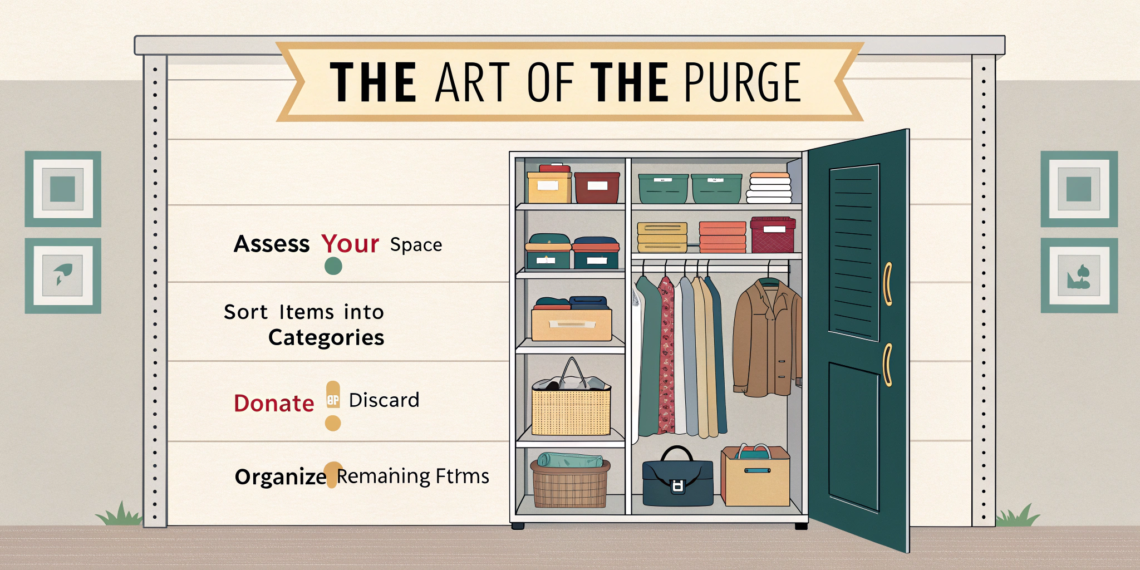
This guide reveals The Art of the Purge, giving you the emotional framework, strategy, and organization tools to finally create lasting order in your deep-storage spaces.
Step 1: Prepare and Empty the Zone
A successful purge requires clearing the canvas completely.
The Clear-Out Rule
- The Mistake: Trying to sort items while they are still in the closet or on the shelf. This leads to distraction and incomplete work.
- The Fix: Completely empty the space. Take everything out of the zone you are working on (the closet, one shelf in the garage, etc.) and place it in the middle of the room. This forces you to see the true volume of clutter and creates a clean slate to reorganize.
- E-E-A-T Insight: Working in small, defined zones (e.g., only the left side of the closet) prevents burnout. If the project is too big, break it into smaller, 2-hour segments.
Gather Your Tools
Before you start, set up your “Decision Stations” using large, clearly labeled bins or boxes:
- Keep: Items returning to the space.
- Donate/Give Away: Items leaving for charity.
- Sell: High-value items to be listed online.
- Toss/Recycle: Damaged, broken, or expired items.
- Relocate: Items that belong in another room (e.g., tools from the closet that belong in the garage).
Step 2: The Sorting and Categorization System
Sort by type, not location. This is the fastest way to reveal duplicate items.
Sort by Category
- The Method: As you process the pile, group like items together. Put all shoes in one area, all holiday decor in another, and all old electronics in a third.
- The Revelation: Seeing all your items in one category (e.g., three separate bins of unused extension cords, or five identical white T-shirts) makes the decision to purge much easier.
The Decision-Making Framework
For every item, ask three critical questions to facilitate the decision:
- Do I use it? (The Six-Month Rule for clothes/general items; the One-Year Rule for seasonal items/tools.) If no, it goes.
- Do I love it? (The sentimental question.) If it brings you joy, you can keep it, but it must be stored meaningfully.
- Would I buy it today? If you saw this exact item in a store, would you spend money on it again? If no, it goes.
Step 3: Making Tough Calls (Dealing with the Keep Pile)
Once the toss/donate piles are complete, you must manage what remains—the Keep pile.
The Hangar Trick (Clothing/Closet Focus)
- The Method: Turn all the hangers in your closet backward. When you wear an item, turn the hanger forward.
- The Result: After six months to one year, every hanger that is still backward holds an item you have not worn. These items are the easiest to donate.
The Sentimental System (Attic/Garage Focus)
- The Problem: Sentimental clutter (old letters, kid’s art, heirlooms).
- The Fix: Limit sentimental items to one or two designated, clearly labeled archival bins. If the bin is full, a new item can only come in if an old item leaves. This forces intentional selection.
- Internal Link: [Anchor text: “digital declutter” to the Smart Living post on digitizing photos and art for sentimental items].
Step 4: Reorganize and Automate Maintenance
The final step is to put the Keep pile back using a systematic organization strategy that supports long-term order.
Organizing with Zones and Uniformity
- Zone by Use: Dedicate specific areas for categories (e.g., the bottom shelf of the garage for Automotive, the top for Seasonal Decor). Items should always return to their assigned zone.
- Container Uniformity: Use matching, stackable, clear plastic bins with tight lids (especially in the garage/attic to protect against dust/pests). Uniform containers look tidy and maximize vertical space.
- Labeling: Labels are non-negotiable. The label should describe the contents, not the category (e.g., “Christmas Tree Lights” not just “Holiday”). (Internal Link: Link to the ‘Organizing High-Traffic Zones’ post on the power of clear labels.)
The Maintenance Loop
- The Rule: Implement the One In, One Out rule for all subsequent purchases. If you buy a new piece of clothing, an old one must be donated. If you buy a new tool, an old, broken, or unused tool must be purged.
- The Monthly Scan: Schedule a 10-minute check of your deep-storage zones monthly to ensure everything is in its assigned container.
4. FAQ Section (Ready for Schema Markup)
Q: How do I get rid of the “Sell” pile easily?
A: Give yourself a strict, 30-day deadline to list items on local online marketplaces (like Facebook Marketplace or Craigslist). If an item doesn’t sell within 30 days, move it immediately to the Donate pile. Time is more valuable than the small return on high-effort sales.
Q: What do I do with old paint cans in the garage?
A: Do not throw old paint in the trash. The proper disposal method is to take it to a local hazardous waste collection center. If there is only a small amount of latex paint left, you can dry it out (mix with cat litter or sand) and throw it away, but check local rules first.
Q: How do I store clothing that is not seasonal?
A: Use vacuum seal bags for off-season clothing (winter coats, heavy sweaters). They compress the volume by up to 75%, making them easy to store under the bed or on high shelves in the attic.
Q: Should I organize by color or function in a clothing closet?
A: Organize by function first, then by color. Group all shirts together, all pants together, all dresses together. Then, organize each group by color (light to dark). This streamlines morning dressing.
Q: Can I keep empty boxes for electronics/appliances?
A: Only keep the original box if the item is still under warranty or if you plan to resell it immediately. Otherwise, the box takes up valuable storage space and should be broken down and recycled. Store manuals digitally.
Q: Where should my Relocate items go immediately?
A: Place all Relocate items in a single laundry basket and set a timer for 15 minutes to put them into their proper homes right away. Do not let the Relocate bin sit, as it becomes its own new pile of clutter.